



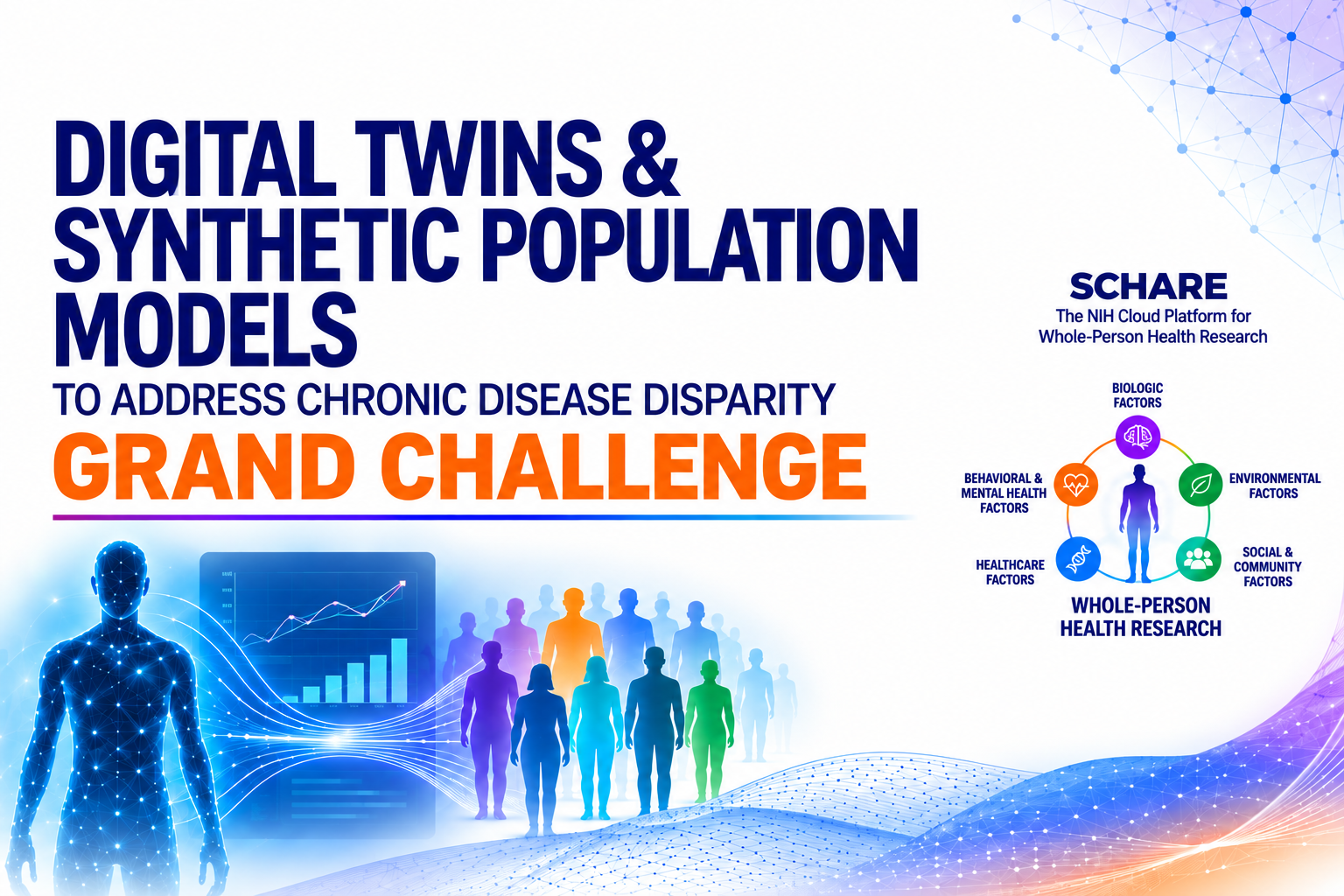
 This Grand Challenge seeks innovative digital twin and synthetic population modeling approaches that advance whole-person/exposome chronic disease research and/or health care by integrating real-world biomedical, behavioral, mental health, environmental, healthcare, and community data into AI-ready computational models. Participants are challenged to develop digital twins, synthetic populations, or hybrid computational simulation platforms capable of generating scientifically valid, representative, and reusable models that support discovery, prevention, intervention development, and/or public health decision-making across the continuum of biomedical, behavioral, mental health, and population science. Solutions may address individual-level digital twins, population digital twins, community simulations, or multiscale models spanning the scientific continuum from basic science through applied public health research or interventions.
The Challenge will be conducted in 2 phases, and only the winners of Phase I are eligible to compete in Phase II.
Challenge Launch: September 21, 2026
Phase 1 Deadline, April 19, 2027
Total cash prizes: $1,000,000
OVERVIEW
Challenge Statement
This challenge emphasizes the development of scientifically rigorous methodologies that preserve whole person biological realism (exposome), maintain population representativeness, quantify uncertainty, and support trustworthy AI across diverse populations. Through the use of digital twins and population simulators, the Challenge seeks to identify actionable intervention targets for a chronic disease and develop solutions that mitigate any of these health disparity metrics:
- Greater Incidence and/or prevalence of preclinical disease/biomarker or clinical diseases/disorders/conditions
- Higher rates of disability adjusted life years or prevalence of short-term and/or long-term preventable complications
- Earlier onset of disease/disorders/conditions
- Higher prevalence of modifiable risks, health risk behaviors, & adverse clinical outcomes
- Premature or excessive morbidity and mortality from specific conditions
- Lower rates of life expectancy, health-related quality of life, and/or daily functioning in physical, cognitive, or socio-emotional domains
- Variations in the access, utilization, availability and/or quality health care
Scientific Challenge
Chronic diseases remain the leading causes of preventable illness, disability, and premature death in the United States. However, health is not determined by biology alone. Gene expression, proteomic profiles, immune function, metabolism, inflammation, and other biological processes are continuously shaped by environmental exposures, chronic stress, nutrition, housing conditions, neighborhood characteristics, healthcare access, behavioral factors, and other contextual factors. These interactions occur throughout the life course and differ across individuals and communities, making chronic disease a dynamic, whole-person phenomenon (exposome), rather than the result of isolated biological abnormalities.
Although biomedical science has generated unprecedented advances in genomics, proteomics, metabolomics, imaging, wearable technologies, electronic health records, and environmental monitoring, these data are typically analyzed in isolation. Traditional research approaches are not well suited to studying these complex, interconnected systems. Most existing analytic methods rely on fragmented datasets collected at single points in time and rarely integrate the multiple domains needed to understand the mechanisms driving chronic disease disparities. Similarly, healthcare often relies on episodic clinical encounters that provide only a limited snapshot of an individual's health, missing the broader biological, behavioral, environmental, and community context that shapes health trajectories. As a result, researchers and healthcare systems often fail to understand how biological processes interact with the real-world living conditions and receive care to influence disease risk, progression, treatment response, and health outcomes. Without computational methods capable of integrating these multidimensional data over time, opportunities for earlier detection, precision prevention, and targeted intervention are frequently missed.
Artificial intelligence is rapidly transforming biomedical research, healthcare, and public health. However, progress in chronic disease research remains constrained by fragmented datasets, incomplete longitudinal information, limited representation of many populations, privacy concerns, and insufficient methods for modeling the complex interactions among biological, behavioral, environmental, healthcare, and community factors that influence health across the lifespan. Despite growing interest, most current digital twins and synthetic datasets are disease-specific, narrowly focused, insufficiently validated, difficult to reuse, lack context of living or limited in their representation of whole-person health.
Digital twins and synthetic population models offer a transformative opportunity to address these limitations by creating dynamic, computational representations of individuals and populations that simulate disease progression, treatment response, environmental exposures, living conditions context, health behaviors, healthcare utilization, and intervention outcomes. Digital twins create dynamic computational representations of an individual's evolving health by integrating biological, clinical, behavioral, environmental, and contextual data into continuously updated models that simulate disease progression, treatment response, and intervention outcomes. Synthetic population models extend this capability by creating representative virtual populations that enable researchers and public health practitioners to better understand disease progress, tailored interventions, personalized healthcare delivery strategies, and disease prevention programs before implementing them in real-world settings.
Whole-person digital twins and population simulations can model the complex interactions between biology and contextual factors that contribute to chronic disease poor health outcomes. Rather than treating genetics, proteomics, behavior, environmental exposures, and healthcare utilization as separate risk factors, digital twins and synthetic populations allow researchers to understand how these factors interact over time to influence biological pathways, disease mechanisms, resilience, and treatment response. This capability is essential for identifying why individuals with similar genetic profiles may experience markedly different health outcomes based on differences in housing quality, environmental exposures, food access, transportation, education, chronic stress, healthcare access, or other non-medical drivers of health.
Digital twins also provide a powerful platform for precision prevention by enabling researchers to simulate disease trajectories and evaluate how modifications to biological, behavioral, environmental, or healthcare factors may alter future health outcomes before disease develops. Likewise, synthetic population models allow investigators and public health agencies to evaluate interventions at the community or population level, estimate potential impacts, identify unintended consequences, and optimize resource allocation without exposing real individuals to unnecessary risk.
As artificial intelligence becomes increasingly dependent on synthetic data, there is also growing concern regarding Model Autophagy Disorder (MAD), the progressive degradation of AI models resulting from repeated training on AI-generated data that no longer reflect real-world populations. Preventing MAD requires digital twins and synthetic populations that remain continuously anchored to representative, high-quality biomedical, behavioral, environmental, and healthcare data. MAD and other potential biases must be addressed and prevented.
Primary Goal: Develop scientifically validated digital twin and synthetic population technologies that generate AI-ready whole-person models, including biologics and context of daily living, and capable of accelerating chronic disease discovery, simulating interventions, improving precision prevention, strengthening public health decision-making, and reducing chronic disease disparities at the individual and/or population levels.
This challenge addresses one of the biggest bottlenecks in AI-enabled biomedical research: the lack of representative, reusable, validated digital twins and synthetic population models that accurately reflect whole-person (exposome) health biological systems and the real-world conditions that influence them. By combining genomics, proteomics, biomarkers, clinical data, mental health, behavioral science, environmental exposures, healthcare utilization, community characteristics, and other determinants of health into interoperable, AI-ready computational models, this challenge will create reusable research infrastructure that advances biomedical discovery, strengthens healthcare decision-making, improves public health planning, and accelerates the development of interventions that reduce chronic disease disparities at the individual and/or population levels.
Two Phase Objectives
Develop an innovative proof of concept for a whole-person digital twin, synthetic population model, or integrated computational simulation platform that generates AI-ready models and datasets to advance chronic disease prevention, early detection, disease progression, intervention evaluation, and health outcomes at the individual and/or population level.
Solutions should demonstrate how biological, clinical, behavioral, mental health, environmental, healthcare, community, and living contextual factors data can be integrated into dynamic computational models that accurately represent whole-person health in real-world settings. Proposed models should generate actionable insights into disease mechanisms, predict disease trajectories, evaluate prevention and treatment strategies, and support precision prevention, healthcare delivery, and/or public health decision-making.
Participants should demonstrate how their proposed digital twin or synthetic population methodology advances beyond current computational modeling approaches by improving whole-person integration, biological realism, interoperability, AI-ready data generation, transparency, population representation, scalability, and accessibility. Proposed solutions may develop entirely new modeling frameworks or substantially reimagine existing digital twin, synthetic population, or simulation methodologies. Models should be designed to:
- Integrate real-world biological, behavioral, environmental, healthcare, and community data into dynamic whole-person representations.
- Be applicable across all populations, including rural, low SES, and OMB Directive Racial and Ethnic categories, and adaptable to multiple chronic diseases or health conditions.
- Incorporate methodologies that prevent Model Autophagy Disorder (MAD) by maintaining strong connections to representative real-world data.
- Mitigate at least one of the health disparity metrics (see Challenge Statement)
- Focus on at least one chronic disease.
- Generate reusable, interoperable, AI-ready computational resources that can be shared through SCHARE and used by the broader biomedical, behavioral, healthcare, and public health research communities.
Objective 1. Develop an Innovative Digital Twin or Synthetic Population Framework - Design a novel or substantially reimagined digital twin, synthetic population model, or integrated simulation platform that addresses an important biomedical, mental health, behavioral, or public health challenge related to chronic disease disparities.
Objective 2. Integrate Whole-Person Health Data - Develop a computational framework that integrates multiple dimensions of whole-person health that create dynamic representations of individual or population health, including aspects such as:
- Biological factors (e.g., genomics, proteomics, metabolomics, biomarkers)
- Clinical and electronic health record data
- Mental and behavioral health
- Environmental exposures
- Healthcare utilization
- Community and place-based factors
- Non-medical drivers of health and other contextual influences
Objective 3. Develop AI-Ready Computational Models - Design computational methodologies that generate interoperable, transparent, reusable, and AI-ready digital twins or synthetic populations suitable for machine learning, simulation, prediction, and decision support.
Objective 4. Advance Computational Innovation - Develop innovative computational approaches that improve current or provide new digital twin or synthetic population methodologies based on approaches such as:
- Multiscale or multimodal modeling
- Longitudinal simulation
- Agent-based modeling
- Causal inference
- Systems modeling
- Foundation models
- Bayesian approaches
- Hybrid AI models
- Predictive analytics
- Digital biomarkers
- Uncertainty quantification
Objective 5. Prevent Model Autophagy Disorder (MAD) - Design computational strategies that ensure digital twins and synthetic populations remain scientifically valid by maintaining strong connections to representative real-world data and preventing degradation associated with repeated training on AI-generated data.
Objective 6. Demonstrate Applicability Across Populations - Demonstrate that the proposed framework is designed to:
- Be applicable across diverse populations
- Support either individual- or population-level applications
- Improve representation of populations experiencing chronic disease disparities
- Address a chronic diseases or health conditions and mitigate a health disparity outcome metric
Objective 7. Enable Scientific Discovery and Intervention Development - Demonstrate how the proposed framework can potentially address one or more:
- Improve understanding of disease mechanisms
- Simulate disease progression
- Predict treatment response
- Identify intervention opportunities
- Support precision prevention
- Inform healthcare delivery
- Strengthen public health decision-making
Objective 8. Promote Accessibility, Interoperability, and Reuse - Design the framework to generate computational resources that are:
- AI-ready
- Interoperable with SCHARE
- Accessible to researchers
- Reusable by the scientific community
- Well documented, including user guidance
- Scalable for future research and implementation
Objective 9. Establish Technical Feasibility - Develop a realistic roadmap demonstrating how the proof of concept will mature into a validated, operational digital twin or synthetic population platform during Phase II, including major milestones, validation strategies, fit for purpose effectiveness, anticipated risks, and implementation considerations.
The purpose of Phase II is to develop, validate, and demonstrate a fully operational whole-person digital twin, synthetic population model, or integrated computational simulation platform that advances chronic disease research, health disparity metric, and public health by generating scientifically valid, AI-ready computational models and simulation environments.
Building upon the Phase I concept, participants will deliver a functional product capable of integrating biological, clinical, behavioral, mental health, environmental, healthcare, community, and place-based data into dynamic computational models that represent individuals and/or populations across the life course.
The final product should demonstrate scientific validity, computational performance, interoperability, accessibility, bias mitigations (including MAD), and usability, while enabling researchers to investigate disease mechanisms, simulate interventions, evaluate healthcare strategies, forecast population outcomes, impact health disparity metric(s), and improve chronic disease prevention and management. Products should be designed for broad adoption through SCHARE and other interoperable research ecosystems.
Objective 1. Develop a Functional Digital Twin or Synthetic Population Platform/Model - Develop and demonstrate a fully operational digital twin platform, synthetic population modeling system, or integrated simulation environment capable of representing whole-person (exposome) health at the individual and/or population level.
Objective 2. Validate Whole-Person Computational Models - Validate computational models using real-world data demonstrating integration of any or all of the following:
- Biological systems (genomics, proteomics, metabolomics, biomarkers)
- Clinical and EHR data
- Mental health
- Behavioral health
- Environmental exposures
- Chemicals/plastics
- Healthcare utilization
- Community and place-based characteristics
- Lived experiences
- Other biological and contextual drivers of health
Objective 3. Generate AI-Ready Computational Resources - Develop computational resources that generate, as applicable:
- AI-ready datasets
- Synthetic datasets
- Integrate non-medical drivers of health data
- Digital twin outputs
- Metadata
- Data dictionaries
- Computational workflows
- Reusable simulation outputs
Objective 4. Demonstrate Computational Innovation - Implement and validate innovative computational methods including, as appropriate:
- Digital twins
- Synthetic populations
- Longitudinal simulation
- Agent-based modeling
- Systems modeling
- Foundation models
- Causal inference
- Bayesian approaches
- Hybrid AI
- Predictive analytics
- Digital biomarkers
Objective 5. Demonstrate Model Integrity - Demonstrate strategies such as:
- Prevent Model Autophagy Disorder (MAD)
- Maintain biological realism
- Preserve population representativeness
- Fit for purpose
- Integration of real world whole person data living conditions
- Quantify uncertainty
- Support transparent and trustworthy AI
Objective 6. Demonstrate Research, Healthcare, and Public Health Utility - Demonstrate how the platform can support any or all of the following:
- Biomedical research
- Mental health research
- Behavioral science
- Precision prevention
- Healthcare delivery
- Non-medical drivers of health – contextual factors of living
- Clinical decision support
- Population health planning
- Public health surveillance
- Intervention evaluation
Objective 7. Deliver Reusable Scientific Infrastructure - Produce reusable computational resources for chronic diseases that are:
- Interoperable
- Accessible
- Representative of targeted populations
- AI-ready
- Well documented
- Cloud compatible
- SCHARE-ready
- User Friendly ready
VISION
By the end of the Grand Challenge, participants will have developed a validated whole-person digital twins and/or synthetic data population simulation models for biomedical, behavioral, mental health, healthcare, and public health research and/or health care. By integrating biological systems with environmental exposures, healthcare experiences, community characteristics, and contextual living experiences into interoperable, AI-ready computational models, these technologies will enable researchers to simulate disease trajectories, identify mechanistic pathways, evaluate interventions, and predict health outcomes before implementation in the real world. Grounded in representative real-world data and designed to prevent Model Autophagy Disorder (MAD), the challenge will produce reusable, accessible computational resources through SCHARE that transform chronic disease disparities research from describing health outcomes to predicting, preventing, and mitigating them at the individual and population levels.
PRIZES
Total cash prizes
$1,000,000
Prize Description
The Challenge will be conducted in 2 phases, and only the winners of Phase I are eligible to compete in Phase II.
- Phase I — IMAGINE AND DESIGN: Prototype Development
Awards: First Place: $140,000
Second Place: $130,000
Third Place: $120,000
Fourth Place: $110,000 - Phase II — BUILD, VALIDATE, DEMONSTRATE: Functional applicable validated Digital Twin and/or Synthetic Population Model
Awards: First Place: $300,000
Second Place: $200,000
TIMELINE
- Challenge Launch: September 21, 2026
- Registration Deadline: February 19, 2027
- Phase I
- Submission Open: September 25, 2026
- Submission End: April 19, 2027
- Winners Announced: June 11, 2027
- Phase II
- Submission Open: June 14, 2027
- Submission End: December 13, 2027
- Winners Announced: Jan 14, 2028
JUDGING
The purpose of Phase I is to identify the most innovative concepts that have the potential to transform whole-person chronic disease research by creating AI-ready datasets, advancing computational methods, and developing reusable data science infrastructure.
Phase I focuses on the quality measure the quality, innovation, feasibility, and potential impact of the proposed concept from a new or re-imagined design.
Submissions will be evaluated by an independent panel of experts with backgrounds in chronic disease research, artificial intelligence, biomedical informatics, data science, statistics, computational biology, population health, cloud computing, and related disciplines. Participants receiving the highest overall scores and meeting the minimum advancement threshold will be invited to participate in Phase II.
Only projects that use data science strategies to address whole person (exposome) chronic disease health disparity will be considered for this Challenge. Prefer to include the use of SCHARE data sets and resources.
| Evaluation Components | Points |
|---|---|
| Whole-Person Digital Twin or Synthetic Population Concept | 25 |
| Investigator, Team, or Entity Qualifications | 15 |
| Scientific Impact and Innovation | 20 |
| Whole-Person Data Integration and AI-Ready Strategy | 20 |
| Computational Innovation | 10 |
| Development Feasibility and Phase II Readiness | 10 |
| Total | 100 |
- Whole-Person Digital Twin or Synthetic Population Concept (25 Points) - Question: Does the proposal present a compelling, innovative concept that advances whole-person computational modeling for chronic disease research? Outstanding proposals should demonstrate a transformative approach that substantially advances current digital twin or synthetic population methodologies. Reviewers should evaluate such components as:
- Significance of the chronic disease(s) or health condition(s) being addressed.
- Importance of the individual- and/or population-level problem.
- Strength of the scientific rationale.
- Integration of a whole-person health framework.
- Novelty of the digital twin or synthetic population methodology.
- Degree to which the approach is new or substantially reimagined.
- Advancement beyond current modeling approaches.
- Relevance to biomedical, behavioral, mental health, healthcare, or public health applications.
- Likelihood to impact a health disparity metric
- Potential scientific and public health impact.
- Investigator, Team, or Entity Qualifications (15 Points) - Question: Does the team have the expertise, experience, and organizational capacity to successfully develop and implement the proposed technology? Higher scores will be awarded to teams demonstrating complementary trans-discipline expertise, successful collaboration, and the capacity to deliver the proposed work.
- Multidisciplinary Team Composition and Expertise (5 Points) - Reviewers will evaluate whether the proposal includes appropriate expertise and clearly defined roles and area of expertise for:
- Principal Investigator
- Co-Investigators
- Collaborators
- Partner organizations
- Industry partners (if applicable)
Scientific and Technical Expertise (10 Points) Collectively, the team should demonstrate expertise in areas relevant to the proposed work, including disciplines such as:
Biomedical Sciences
- Genomics
- Proteomics
- Multi-omics
- Physiology
- Biomarkers
- System biology
Behavioral and Mental Health
- Behavioral science
- Mental health
- Population health
- Whole-person health (exposome)
Data Science and Artificial Intelligence
- Artificial intelligence
- Machine learning
- Foundation models
- Digital twins
- Synthetic populations
- Predictive analytics
- Computational modeling
- Bayesian statistics
- Causal inference
Biomedical Informatics
- Electronic health records
- Data integration
- Metadata
- Common data elements
- Interoperability
- Cloud computing
Computer Science and Engineering
- Software engineering
- Systems architecture
- Cloud platforms
- APIs / MCPs
- High-performance computing
Public Health
- Epidemiology
- Environmental health
- Community health
- Geospatial analytics
- Population health/science
- Chronic disease prevention/intervention/research
- Health disparities research
- Multidisciplinary Team Composition and Expertise (5 Points) - Reviewers will evaluate whether the proposal includes appropriate expertise and clearly defined roles and area of expertise for:
- Scientific Impact and Innovation (20 Points) - Question: If successful, how significantly will this innovation advance chronic disease research and improve health? Reviewers should evaluate the potential to at least one or more of the following:
- Advance whole-person chronic disease research.
- Improve understanding of disease mechanisms.
- Integrate biological systems with environmental and social context.
- Improve disease prevention, early detection, monitoring, or intervention.
- Improve health at the individual and/or population levels.
- Be applicable to various population groups most impacted by chronic diseases
- Reduce chronic disease disparities.
- Mitigate a health disparity metric.
- Enable AI-driven discovery.
- Support healthcare and public health decision-making.
- Produce broadly applicable scientific resources.
- Whole-Person Data Integration and AI-Ready Strategy (20 Points) - Question: Does the proposal present a compelling strategy for creating scientifically valid, AI-ready real world computational models? Reviewers should evaluate applicable components, such as:
- Integration of biological, behavioral, environmental, healthcare, community, and place-based data.
- Inclusion of non-medical drivers of health
- Exposome models
- AI-ready data generation strategy.
- Real World simulation models
- Metadata and provenance.
- Interoperability.
- Population representation.
- Reusability.
- Fit for Purpose Strategies
- Transparency.
- Strategy for preventing Model Autophagy Disorder (MAD).
- Computational Innovation (10 Points) - Question: Does the proposal advance computational science? Higher scores will be awarded to proposals that clearly advance the state of the science rather than adapting existing methods or building the same insufficient models with only minor modifications. Reviewers should evaluate approaches, such as:
- Real world Digital twin methodology
- Real World Synthetic population methodology
- Longitudinal simulation
- Foundation models
- Agent-based modeling
- Systems modeling
- Causal inference
- Bayesian approaches
- Hybrid AI
- Predictive modeling
- Digital biomarkers
- Other - new approach
- Development Feasibility and Phase II Readiness (10 Points) - Question: Is there a realistic pathway to developing a validated operational platform? Reviewers should evaluate Likelihood of successful completion in Phase I, such as:
- Technical feasibility
- Development roadmap
- Milestones
- Validation strategy
- Risk assessment
- Risk mitigation
- Scalability
- Barriers to completion
| Evaluation Criterion | Points |
|---|---|
| Functional Product Performance and Model Integrity | 25 |
| Scientific Validity and Whole-Person Integration | 15 |
| Computational Innovation and Computational Resources | 15 |
| AI-Ready Real World Data and Scientific Impact | 15 |
| Population Applicability, Generalizability and Utility | 10 |
| Research, Healthcare, and Public Health translation accessibility and adoption | 10 |
| Technical Documentation, and User Experience | 10 |
| Total | 100 |
- Functional Product Performance and Model Integrity (25 Points) Higher scores will be awarded to platforms demonstrating reliable performance and scientifically credible model outputs. Reviewer Question: Has the team successfully developed a functional, scientifically robust digital twin or synthetic population platform that performs as intended? Reviewers will evaluate applicable components:
- Functionality and technical performance of the operational platform.
- Model stability, reliability, and computational efficiency.
- Scientific robustness and internal consistency.
- Addresses a chronic disease disparity
- Mitigates a health disparity outcome metric
- Accuracy of digital twin or synthetic population representations.
- Model integrity and preservation of biological realism.
- Prevention of Model Autophagy Disorder (MAD).
- Scalability for individual- and population-level applications.
- Scientific Validity and Whole-Person Integration (15 Points) Higher scores will be awarded to platforms demonstrating comprehensive whole-person integration and scientifically meaningful outputs. Reviewer Question: Does the platform accurately integrate whole-person health into scientifically valid computational models. Reviewers will evaluate:
- Validation using real-world data.
- Integration of biological, clinical, behavioral, mental health, environmental, healthcare, community, and non-medical drivers of health data.
- Representation of dynamic interactions of integrated components age specific or across the life course.
- Ability to identify mechanistic pathways contributing to chronic disease-prevention, diagnosis, treatment, disease management etc.
- Prevention of MAD and other potential biases
- Scientific validity across diverse populations.
- Longitudinal modeling capability.
- Computational Innovation and Computational Resources (15 Points) Higher scores will be awarded to platforms that substantially advance computational methodologies while providing reusable research resources. Reviewer Question: Does the platform advance computational science and provide reusable computational resources? Reviewers will evaluate applicable aspects:
- Novelty of computational methods.
- Advancement beyond existing digital twin or synthetic population methodologies.
- AI, machine learning, simulation, and systems modeling approaches.
- Explainability and transparency.
- Dynamic interaction of whole person medical and non-medical drivers of chronic disease
- Fit-for-purpose and representation of applicable populations
- Reproducibility.
- Computational efficiency and scalability to determine intervention points
- Availability of reusable computational workflows, APIs, notebooks, software libraries, or simulation tools.
AI-Ready Real-World Data and Scientific Impact (15 Points) Higher scores will be awarded to platforms producing trustworthy, interoperable, and reusable AI-ready data resources.
Real World Data - Reviewer Question: Does the platform generate scientifically valid, AI-ready computational resources grounded in real-world data? Reviewers will evaluate aspects, such as:
- Integration of real-world data.
- AI-ready datasets and simulation outputs.
- Metadata completeness.
- Data provenance.
- Population representation.
- Data quality and completeness.
- Interoperability.
- Reusability.
- Transparency.
- Fit-for-purpose validation.
- Mitigation of data hallucinations or other misrepresentations of data
Scientific Impact - Reviewer Question: Does the completed platform have the potential to transform whole-person chronic disease disparities research? Reviewers will evaluate whether the platform applicable aspects, such as:
- Advances whole-person chronic disease research.
- Improves understanding of disease mechanisms.
- Enables AI-driven discovery.
- Supports intervention development and evaluation.
- Improves healthcare and public health decision-making.
- Produces reusable scientific infrastructure.
- Has broad scientific, clinical, and public health impact.
- Demonstrates long-term value to the research community.
- Population Applicability, Generalizability, and Utility (10 Points) Higher scores will be awarded to platforms demonstrating broad applicability and practical utility. Reviewer Question: Can the platform be applied across diverse populations and real-world settings? Reviewers will evaluate factors, such as:
- Applicability and appropriateness across populations experiencing chronic disease disparities.
- Generalizability across age groups, biological sex, geographic settings, OMB Directive Racial and Ethnic categories, and socioeconomic contexts.
- Utility for individual and population-level applications.
- Adaptability to multiple chronic diseases.
- Fluctuation of dynamic contributing factors to determine role of medical and non medical drivers of chronic disease
- Support for precision prevention and intervention planning.
- Potential to improve health disparity outcomes and reduce chronic disease disparities.
- Research, Healthcare, and Public Health Translation, Accessibility, and Adoption (10 Points) Higher scores will be awarded to platforms with clear pathways to implementation, easy adoption and widespread use. Reviewer Question: Can the platform be readily adopted by researchers, healthcare systems, and public health organizations? Reviewers will evaluate conditions such as:
- Utility for biomedical, behavioral, and mental health research.
- Utility for healthcare decision support.
- Utility for public health planning and surveillance.
- Accessibility to intended users.
- Interoperability with SCHARE and other research ecosystems.
- Readiness for implementation.
- Potential for broad adoption.
- Technical Documentation and User Experience (10 Points) Higher scores will be awarded to platforms that are intuitive, well documented, and easy to implement. Reviewer Question: Is the platform well documented, accessible, and easy to use? Reviewers will evaluate factors, such as:
- Quality of technical documentation.
- User guides and training materials.
- Installation and implementation documentation.
- User interface and overall usability.
- Ease of deployment and maintenance.
- Phase I: Can they imagine and design a transformative solution?
- Phase II: Did they build, validate, and deliver a scientifically robust, reusable platform?
Basis Upon Which a Winner Will be Selected
To successfully complete the Grand Challenge, participants must demonstrate that they can develop a validated, operational digital twin or synthetic population platform that:
- Integrates biological, clinical, behavioral, mental health, environmental, healthcare, community, and place-based data into whole-person computational models.
- Address at least one chronic disease and mitigates at least one health disparity outcome metric.
- Generates scientifically valid, AI-ready digital twins and/or synthetic populations suitable for biomedical research, healthcare, and public health applications.
- Incorporates robust methods to prevent Model Autophagy Disorder (MAD) and maintain biological realism and population representativeness.
- Produces interoperable, reusable computational resources—including AI-ready datasets, simulation outputs, APIs, and workflows—that can be shared through SCHARE.
- Demonstrates practical utility for advancing disease mechanism discovery, intervention evaluation, precision prevention, healthcare planning, and population health decision-making.
- Is accessible, well documented, scalable, and accompanied by a clear implementation and sustainability plan that supports adoption by researchers, healthcare organizations, and public health agencies.
- Provides tangible evidence of their ability to build an interactive dynamic digital twin or population model that responds to variations in drivers input and manipulation
By the end of Phase I, participants should have demonstrated that they have:
- Developed a scientifically soundproof concept for a whole-person (exposome) digital twin or synthetic population model.
- Established a credible strategy for integrating real-world biological and contextual data into AI-ready computational models.
- Designed a framework that is broadly applicable across diverse populations and chronic disease(s).
- Developed innovative computational methods with the potential to improve mechanistic discovery, simulation, and intervention evaluation.
- Demonstrates a potential to mitigate a health disparity outcome metric and/or improve public health outcomes.
- Established a clear pathway to building and validating a fully operational platform in Phase II.
There must be a score of at least 80 in Phase I. This Phase II framework completes the progression from imagining and designing a transformative computational approach in Phase I to delivering a validated, deployable scientific digital twin or synthetic data population model addresses real world whole-person chronic disease disparities research and/or health care.
To successfully complete the Grand Challenge, participants should demonstrate that they have developed a validated, operational whole-person digital twin, synthetic population model, or integrated simulation platform that:
- Produces scientifically valid, AI-ready digital twins and/or synthetic populations that accurately represent whole-person health at the individual and/or population level.
- Impacts a chronic disease trajectory and a health disparity outcome metric, including improved population health
- Integrates biological, clinical, behavioral, mental health, environmental, healthcare, community, and place-based data into dynamic computational models grounded in real-world data.
- Demonstrates computational innovation that advances beyond current digital twin or synthetic population methodologies and includes safeguards to prevent Model Autophagy Disorder (MAD).
- Generates interoperable, reusable AI-ready datasets, computational models, simulation outputs, metadata, and workflows that are fit for purpose and accessible to the broader research community.
- Demonstrates scientific validity, transparency, reproducibility, and generalizability across diverse populations and chronic disease applications.
- Identifies mechanistic pathways, predicts disease trajectories, simulates interventions, or supports precision prevention and healthcare or public health decision-making.
- Includes user-friendly dashboards, visualization tools, APIs, software, documentation, and training materials that facilitate adoption by researchers, healthcare systems, and public health agencies.
- Demonstrates interoperability with SCHARE and other standards-based research ecosystems and includes a clear implementation and sustainability plan for long-term use.
If scores are tied, priority will be given to projects demonstrating:
- Greater potential to reduce chronic disease disparities, including one or more health disparity metrics
- Stronger integration of whole-person health concepts
- Broader scalability and public health impact
- Stronger evidence of trustworthy AI and responsible innovation
Award Thresholds
| Final Score | Recommendation |
|---|---|
| 94-100 | Outstanding – Strong Candidate for Winner |
| 87-93 | Excellent – Highly Competitive |
| 80-86 | Very Good – Competitive |
| 70–79 | Good |
| Below 70 | Not Competitive |
HOW TO ENTER
Registration Process:
All interested Participants must register and complete the form on the official challenge portal by going to https://forms.cloud.microsoft/g/Lp3sWGLj4F (when successfully submitted you will receive a response that states that “your registration was submitted” and register for prize payment https://sam.gov/content/entity-registration by the registration deadline on 2/19/2027.
The Individual, Team Leader or Point of Contact must register on the Challenge website.
Upon registering, participants will be required to identify whether they are registering as either of the following: as an individual, independent Team (i.e., registering as a group of individuals competing together but not on behalf of an established organization, institution, or corporation) or as an Entity (i.e., registering as a group of individuals competing together on behalf of a legally established organization, institution, or corporation). Participants will need to provide the name, affiliation, and contact information of all individuals competing in this Challenge as part of a Team or on behalf of an Entity. All Participants will also be required to acknowledge whether federal funding will be used in the development of the Challenge submission (see Participation Rule 1). All Participants must certify they have read, understand, and agree to abide by the official eligibility rules, participation rules, and requirements for the Challenge as stated in this announcement.
Once the registrant is deemed eligible, a link to a secure BOX folder specified for you/your team will be sent, so you can upload your submissions. This will enable large files to be submitted if needed.
Submission Process:
For your submission to be eligible for judging, you must:
Be a U.S. citizen.
Be eligible to compete as an Individual or as part of a Team or Entity (see Eligibility Rules).
For Teams: Each participating Team is required to identify a Team Leader who will register and submit on behalf of the Team members. The Team Leader is responsible for all communications with the Challenge sponsors and, in the event of winning a cash prize, the prize will be paid in full. To be eligible to receive a cash prize, the Team Leader must be a citizen of the United States. Non-citizens can participate but cannot receive payment. In the event that a dispute regarding the identity of the Team Leader who actually submitted the entry cannot be resolved to NIH’s satisfaction, the affected submission will be deemed ineligible.
For Entities: Each participating Entity is required to identify a Point of Contact who will register and submit on behalf of the Entity. The Point of Contact is responsible for all communications with the Challenge sponsors. In the event of winning a cash prize, the prize will be paid directly to the Entity, not to the Point of Contact. To be eligible to receive a cash prize, the Entity must be incorporated in and maintain a primary place of business in the United States. As stated in the Participation Rules, Participants intending to use Federal grant, cooperative agreement, or other transaction (OT) award funds must register for and participate in the Challenge as an Entity on behalf of the awardee institution or organization. In the event that a dispute regarding the identity of the Point of Contact who actually submitted the entry cannot be resolved to NIH’s satisfaction, the affected submission will be deemed ineligible.
Proposal Submission Format
- Upload your responsive proposal and supporting documents in PDF format through the designated Box Folder provided after eligibility determination by the due date April 19, 2027.
- All submissions must be written in English and cannot be handwritten.
- Submissions must not include the HHS’ logo or official seal or the logo of NIH or any of its components and must not claim federal government endorsement.
- Submissions to Phase 1 must follow the structure outlined below and adhere to the stated page limits. Do not include any proprietary or confidential information in the Title, Executive Summary, and Plain Language sections as they may be publicly shared if the participant is selected to win a prize across any phase of this Challenge (see Participation Rule 7).
- Components must not claim federal government endorsement.
- Generative Artificial Intelligence (AI) should not be used to develop the writing, imagery, or data of a submission.
- Each Individual or Team may only propose 1 solution. An Entity may submit multiple entries provided there isn’t substantial overlap in team members, the team leaders are not the same, and each entry has a distinct and separate focus.
- ✓ COVER PAGE (1 page)
- Submission Title
- Individual/Team/Entity Name
- Team/Entity location (City, State)
- ✓ EXECUTIVE SUMMARY (1 page): Provide a summary of your submission that can be easily understood by a general audience. Overview of innovation, chronic disease challenge, target population(s), expected impact, and significance. A concise summary of your proposed solution, emphasizing its significance, innovation, human-relevance, and feasibility. Note that the winners’ Executive Summary section will be shared publicly.
- ✓ PLAIN LANGUAGE SUMMARY (0.5 page): Describe your technical proposal in a manner that ensures the main ideas and impacts are clear and accessible to those without specialized knowledge or technical background in the field. This summary will be made public for winners and used for broader dissemination to inform the public about the will be contributions and significance of your work. Not included in total pages.
- ✓ INVESTIGATOR OR TEAM OR ENTITY – provide qualification and contribution of each member. Investigators should have expertise to address all aspects of the project. No more than 2 pages per key team members. Attach as an appendix, not included in total pages.
✓ PROJECT DESCRIPTION AND DATA (12) pages, including all figures (except those listed below the project description), tables, and data, but excluding references. Below are suggestions for clarity:
Overview – Scientific Vision and Problem Significance - Overview of innovation, chronic disease challenge, health disparity outcome, target population(s), expected impact, and significance. Describe the vision of how the proposed technology or device will:
- Chronic disease(s) or chronic disease risk factors being addressed
- Individual and/or population health problem tool can solve (health disparity outcome metric)
- Target population(s) – Individual or Population-level
- Scientific rationale for this proposed approach
- Whole-person health (exposome) framework
- Intended AI and public health applications
Technical Narrative
AI-Ready Data Strategy Describe data sources, metadata, provenance, interoperability, fit-for-purpose strategy, model integrity, and AI-readiness.
Whole-Person Digital Twin or Synthetic Population Concept Proposal - Describe the scientific rationale, whole-person framework, novelty, target disease(s), intended use, expected impact, and advancement beyond current methodologies.
Population Representation and Generalizability Applicability Plan - Demonstrate applicability across diverse populations and describe how the model will improve mechanistic discovery, intervention evaluation, and generalizability.
Computation - AI-Ready Whole-Person Modeling Framework - Describe the whole-person data integration strategy, AI-ready data strategy, computational methodology, interoperability, metadata, model integrity, fit-for-purpose approach, and MAD prevention strategy.
Model Integrity and MAD Prevention Strategy - Describe strategies to maintain scientific validity, prevent Model Autophagy Disorder (MAD), minimize bias, and ensure transparency and reproducibility.
Scientific Validation Strategy - Describe how the model will be validated using real-world data, evaluated for biological realism, and tested for population generalizability.
Scientific Discovery Plan - Describe how your proposed model will generate actionable scientific insights by integrating whole-person data to improve understanding, prediction, prevention, or mitigation of chronic disease disparities across diverse populations.
- FIGURES – 1 page each (not included in project description 12 pages)
- ✓ Conceptual Impact Pathway - Illustrate how the innovation advances from computational modeling to mechanistic discovery, intervention development, and reduced chronic disease disparities.
- ✓ Conceptual Architecture Diagram - Illustrate whole-person data integration, computational framework, AI workflows, interoperability, and SCHARE integration.
- ✓ Whole-Person Data Integration Framework - Illustrate how biological, clinical, behavioral, mental health, environmental, healthcare, community, place-based, and lived experience data will be integrated into the model.
- ✓ Computational Architecture Diagram - Illustrate the modeling architecture, simulation engine, AI workflows, interoperability, cloud infrastructure, and SCHARE integration.
- ✓ Development Roadmap - Technical milestones, validation strategy, risks, mitigation strategies, timeline, and expected Phase II product.
✓ REQUIRED EVIDENCE OF FEASIBILITY
Participant should provide sufficient evidence that the proposed digital twin or synthetic population model can be successfully developed. Evidence may include:
- Preliminary computational models or pilot simulations (if available)
- Existing datasets identified for model development
- Data availability and accessibility
- Conceptual workflows demonstrating data integration
- Preliminary algorithms or computational methods
- Published work supporting the scientific rationale
- Preliminary interoperability strategy with SCHARE
- Initial validation plan using real-world data
Preliminary data are encouraged but not required.
Submission Requirements:
Each solver must submit:
- If any team or entity members changed, complete and re-submit the Registration Form.
- Upload your responsive Proposal and supporting documents in PDF or MP4 format through the designated Box Folder provided after eligibility determination by the due date Dec 13, 2027.
- All submissions must be written in English and cannot be handwritten.
- Submissions must not include the HHS’ logo or official seal or the logo of NIH or any of its components and must not claim federal government endorsement.
- Each Phase 2 solution must be based on each Individual/Team/Entities’ respective winning Phase 1 - Imagine proposal.
- Generative Artificial Intelligence (AI) should not be used to develop the writing, imagery, or data of a submission.
For your submission to be eligible for judging, you must:
- Be a Phase I winner.
- Be a U.S. citizen
- Be eligible to compete as an individual or as part of a Team or Entity (see Eligibility Rules).
- For Teams: Each participating Team is required to identify a Team Leader who will register and submit on behalf of the members. The Team Leader is responsible for all communications with the Challenge sponsors and, in the event of winning a cash prize, the prize will be paid in full. To be eligible to receive a cash prize, the Team Leader must be a citizen of the United States. Non-citizens can participate but cannot receive payment. In the event that a dispute regarding the identity of the Team Leader who actually submitted the entry cannot be resolved to NIH’s satisfaction, the affected submission will be deemed ineligible.
- For Entities: Each participating Entity is required to identify a Point of Contact who will register and submit on behalf of the Entity. The Point of Contact is responsible for all communications with the Challenge sponsors. In the event of winning a cash prize, the prize will be paid directly to the Entity, not to the Point of Contact. To be eligible to receive a cash prize, the Entity must be incorporated in and maintain a primary place of business in the United States. As stated in the Participation Rules, Participants intending to use Federal grant, cooperative agreement, or other transaction (OT) award funds must register for and participate in the Challenge as an Entity on behalf of the awardee institution or organization. In the event that a dispute regarding the identity of the Point of Contact who actually submitted the entry cannot be resolved to NIH’s satisfaction, the affected submission will be deemed ineligible.
Final Submission Format
- Submission Packages must follow the structure outlined below and adhere to the stated page limits. Do not include any proprietary or confidential information in the Title, Executive Summary, and Plain Language sections as they may be publicly shared if the participant is selected to win a prize across any phase of this Challenge (see Participation Rule 7)
- Requirements:
- ✓ EXECUTIVE SUMMARY (1 page) Summarize the final product, innovation, target chronic disease(s), scientific impact, implementation, and key accomplishments. (Scientific Impact) Summary of Project in plain English, Anticipated Impact on Mitigating Chronic Disease Disparities, and Investigators roles
- ✓ FINAL TECHNICAL REPORT (up to 4 pages) Describe the operational platform, technical architecture, computational methods, AI-ready data generation, whole-person integration, prevent Model Autophagy Disorder (MAD), and key innovations.
- ✓ SCIENTIFIC VALIDATION REPORT (up to 3 pages) Present validation methods, benchmark comparisons, biological realism, population generalizability, mechanistic discoveries, and performance metrics.
- ✓ UTILITY AND IMPACT ON WHOLE PERSON CHRONIC DISEASE (up to 3 pages) Describe how the tool addresses real world whole person chronic disease disparity prevention, diagnosis or treatment management. Describe the utility for individual and population-level applications and for biomedical, behavioral, and mental health research. Explain how it accurately represents whole-person health at the individual and/or population level. Explain ways tool could be adopted and used to mitigate chronic disease disparities.
- ✓ AI-READY DATA AND MODEL INTEGRITY REPORT (up to 3 pages) Describe AI-ready datasets, metadata, provenance, interoperability, data quality, fit-for-purpose evaluation, and Model Autophagy Disorder (MAD) prevention.
- ✓ AI-READY DATASETS AND METADATA (up to 3 pages) AI-ready datasets, metadata, data dictionary, provenance, and sample outputs that foster fit for purpose and representation of population.
- ✓ COMPUTATIONAL RESOURCES REPORT (up to 3 pages) Describe computational models, APIs, workflows, software libraries, notebooks, reusable simulation tools, and computational innovations.
- ✓ SOURCE CODE AND COMPUTATIONAL RESOURCES Source code, notebooks, APIs, Python/R packages, workflow scripts, containerized software, etc.
- ✓ USER DOCUMENTATION AND TRAINING MATERIALS
- ✓ INTERACTIVE DASHBOARD OR DECISION-SUPPORT TOOL Interactive dashboard, visualization platform, simulation explorer, or decision-support interface.
- ✓ OPERATIONAL PRODUCT DEMONSTRATION Video or live demonstration
- ✓ PARTICIPANT CHANGES not included in page limits. Max 2 pages per participant.
RULES
To be eligible to win a prize under this Challenge, a Participant (whether participating as An individual, Team or Entity):
- Shall have registered to participate in the Challenge under the rules promulgated by the National Institutes of Health (NIH) as published in this announcement;
- Shall have complied with all the requirements set forth in this announcement;
- In the case of a private entity, shall be incorporated in and maintain a primary place of business in the United States, and in the case of an individual, whether participating singly or in a group, shall be a citizen. However, permanent residents, non-U.S. citizens and non-permanent residents can participate as a member of a team that otherwise satisfies the eligibility criteria. Non-U.S. citizens and non-permanent residents are not eligible to win a monetary prize (in whole or in part). Their participation as part of a winning team, if applicable, may be recognized when the results are announced.
- Shall not be a federal entity or federal employee acting within the scope of their employment;
- Shall not be an employee of the Department of Health and Human Services (HHS, or any other component of HHS) acting in their personal capacity;
- Whoever is employed by a federal agency or entity other than HHS (or any component of HHS), should consult with an agency ethics official to determine whether the federal ethics rules will limit or prohibit the acceptance of a prize under this Challenge;
- Shall not be a judge of the Challenge, or any other party involved with the design, production, execution, or distribution of the Challenge or the immediate family of such a party (i.e., spouse, parent, step-parent, child, or step-child).
- Shall be 18 years of age or older at the time of submission.
- Federal grantees and recipients of cooperative agreements or other transaction (OT) awards are eligible to participate in the Challenge but may not use Federal funds from a grant award, cooperative agreement, or OT award to develop their Challenge submission or to fund efforts in support of their Challenge submission unless use of such funds is consistent with the purpose, terms, and conditions of the grant award, cooperative agreement, or OT award. Each Participant intending to use Federal grant, cooperative agreement, or OT award funds must register for and participate in the Challenge as an entity on behalf of the awardee institution, organization, or entity. If a winning Participant uses Federal grant, cooperative agreement, or OT award funds to participate in the Challenge, the prize must be treated as program income for purposes of the original grant, cooperative agreement, or OT award in accordance with applicable Uniform Administrative Requirements, Cost Principles, and Audit Requirements for Federal Awards [2 CFR § 200]. Participants using Federal grant, cooperative agreement, or OT award funds to participate and/or report prize funding as program income (for winning Participants) should coordinate with the awarding official at the federal awarding agency.
- Federal contractors may not use federal funds from a contract to develop their Challenge submissions or to fund efforts in support of their Challenge submissions.
- By participating in this Challenge, each Participant (whether participating as an Individual or as a Team or Entity) agrees to assume any and all risks and waive claims against the federal government and its related entities, except in the case of willful misconduct, for any injury, death, damage, or loss of property, revenue, or profits, whether direct, indirect, or consequential, arising from participation in this Challenge, whether the injury, death, damage, or loss arises through negligence or otherwise.
- By participating in this Challenge, each Participant (whether participating as an Individual or as a Team or Entity) agrees Generative Artificial Intelligence (AI) should not be used to develop the writing, imagery, or data of a submission.
- Based on the subject matter of the Challenge, the type of work that it will possibly require, as well as an analysis of the likelihood of any claims for death, bodily injury, property damage, or loss potentially resulting from Challenge participation, no Participant (whether participating as an Individual or as a Team or Entity) participating in the Challenge is required to obtain liability insurance, or demonstrate financial responsibility, or agree to indemnify the federal government against third party claims for damages arising from or related to Challenge activities in order to participate in this Challenge.
- A Participant (whether participating as an Individual or as a Team or Entity) shall not be deemed ineligible because the Participant used federal facilities or consulted with federal employees during the Challenge if the facilities and employees are made available to all Participants participating in the Challenge on an equitable basis.
- By participating in this Challenge, each Participant (whether participating as an Individual or as a Team or Entity) warrants that they are sole author or owner of, or has the right to use, any copyrightable works that the submission comprises, that the works are wholly original with the Participant (or is an improved version of an existing work that the Participant has sufficient rights to use and improve), and that the submission does not infringe any copyright or any other rights of any third party of which the Participant is aware.
- By participating in this Challenge, each Participant (whether participating as an Individual or as a Team or Entity) grants to the NIH an irrevocable, paid-up, royalty-free nonexclusive worldwide license to reproduce, publish, post, link to, share, and display publicly the submission on the web or elsewhere. Each Participant will retain all other intellectual property rights in their submissions, as applicable. To participate in the Challenge, each Participant must warrant that there are no legal obstacles to providing the above-referenced nonexclusive licenses of the Participant’s rights to the federal government. To receive an award, Participants will not be required to transfer their intellectual property rights to NIH, but Participants must grant to the federal government the nonexclusive licenses recited herein.
- Each Participant (whether participating as an Individual or as a Team or Entity) agrees to follow all applicable federal, state, and local laws, regulations, and policies.
- Each Participant (whether participating as an Individual or as a Team or Entity) participating in this Challenge must comply with all terms and conditions of these rules, and participation in this Challenge constitutes each such Participant’s full and unconditional agreement to abide by these rules. Winning is contingent upon fulfilling all requirements herein.
- As a condition for winning a cash prize in this Challenge, each Participant (whether participating as an Individual or as a Team or Entity) that has been selected as a winner must complete and submit all requested winner verification and payment documents to NIH within 10 business days of formal notification. Failure to return all required verification documents by the date specified in the notification may be a basis for disqualification of a cash prize winning submission.
Disqualification
Submissions may be disqualified for plagiarism, falsification of any information submitted, use of copyrighted material without permission, and use of profanity, violent images, or nudity. NIMHD is not responsible for lost, late, incomplete, invalid, unintelligible, or misdirected entries, which will be disqualified.
Award Approving Official
The Award Approving Official will be Monica Webb Hooper, PhD, (Acting) Director of the National Institute on Minority Health and Health Disparities, or as otherwise delegated.
Payment of the Prize
Prizes awarded under this Challenge will be paid by electronic funds transfer and may be subject to federal income taxes. The Department of Health and Human Services (HHS)/NIH will comply with the Internal Revenue Service withholding and reporting requirements, where applicable. Entities participating in this Challenge are encouraged, but not required, to request and obtain a free Unique Entity ID (UEI), if they have not already done so, via SAM.gov as this will expedite prize payment. Additional information can be found at https://sam.gov/content/entity-registration.
NIH/NIMHD reserves the right, in its sole discretion, to (a) cancel, suspend, or modify the Challenge, or any part of it, for any reason, and/or (b) not award any prizes if no submissions are deemed worthy.
Legal and Participation Terms
Participation in this Challenge does not create a clinician-patient relationship, and content shared on the platform does not constitute medical advice, diagnosis, treatment, guidance, or instruction regarding any disease or health condition. Participants should consult qualified healthcare professionals regarding personal medical decisions or health conditions. The views expressed by participants do not necessarily reflect those of the HHS, NIH, NIMHD or the federal government.
ADDITIONAL INFORMATION
Questions? Email SCHAREChallenges@nih.gov.
Challenge Manager
Deborah Duran, PhD
Point of contact email
durande@nih.gov
Resources
SCHARE (Science Collaborative for Health and AI Reduction of Errors)